


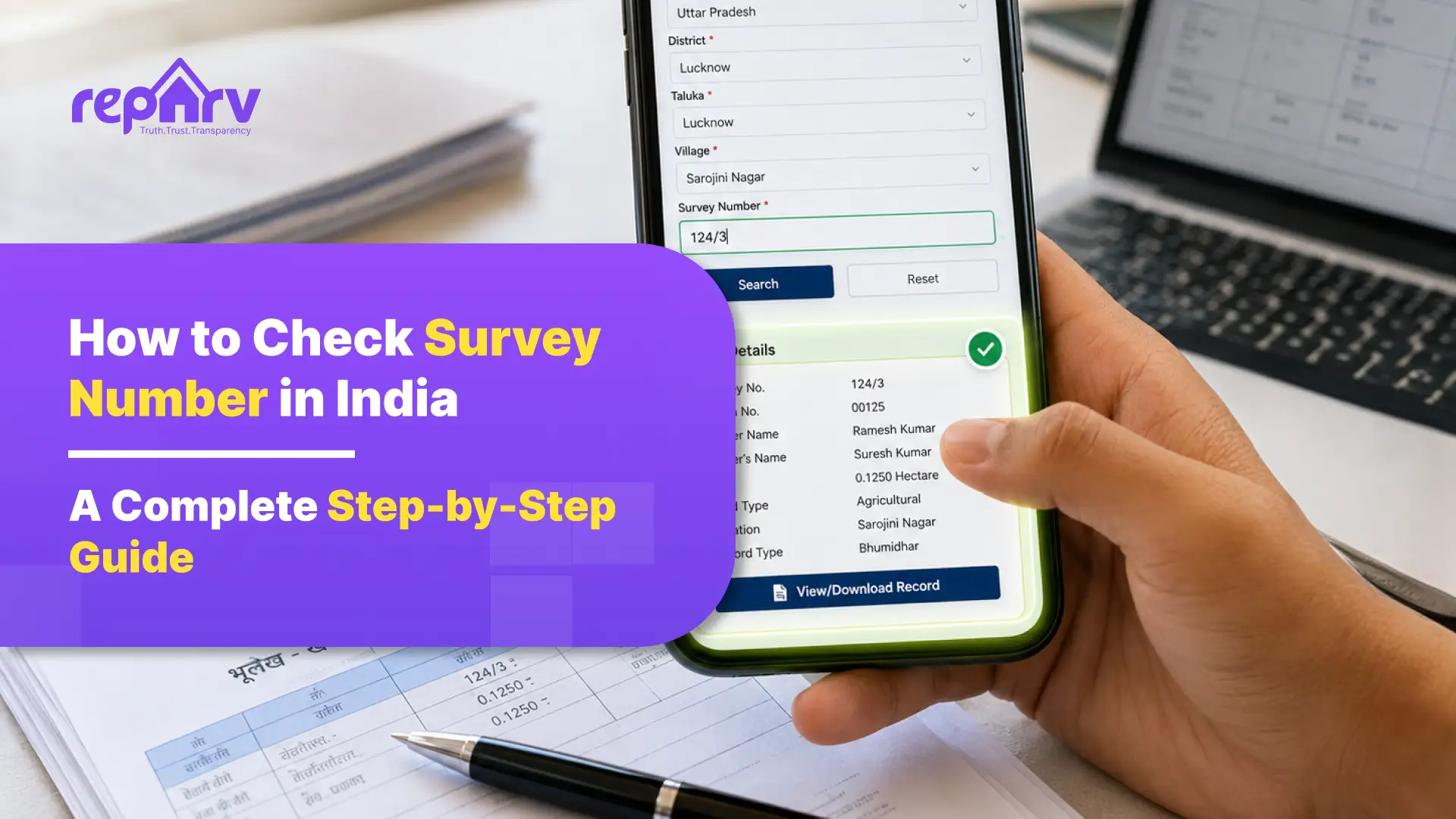
If you have ever bought land, dealt with property inheritance, or applied for a home loan in India, someone has probably asked you for a survey number. And if you had no idea what that meant — you are not alone.
This guide explains exactly what a land survey number is, why it matters, and most importantly, how to check it — whether you are sitting at home with a smartphone or walking into a government office for the first time.
What Is a Survey Number?
A survey number is a unique identification code assigned to a specific piece of land by the state's Revenue Department during an official land survey. Think of it as an Aadhaar number for a plot of land — one number, one parcel, and all the details linked to it.
This number tells you the land's exact location, its size and shape, whether it is agricultural or residential, who owns it, and its legal history. Every transaction — sale, purchase, mortgage, or partition — references this number.
In northern states like Uttar Pradesh, Punjab, and Haryana, the same concept goes by the name khasra number. In Maharashtra, it may be called a gat number. In Tamil Nadu and Karnataka, it is most commonly referred to as the survey number or sy. no. The purpose, however, is identical across all states.
Why Checking Your Survey Number Matters
Skipping survey number verification is one of the most common mistakes property buyers make in India — and it can be a costly one.
Here is why it is essential:
Before buying property: The survey number lets you verify the seller's ownership, check if there are any existing disputes or encumbrances on the land, and confirm that the boundaries match what is described in the sale deed.
For home loans: Banks require the survey number to assess the property's legal status before approving a loan. It helps them confirm the land has a clear title and no pending litigations.
For property registration: You cannot register a sale deed without a valid survey number. It is a mandatory field in all property documents.
For mutation of records: After buying land, the survey number is needed to update the owner's name in revenue records — a step called mutation or dakhil kharij.
During legal disputes: Courts and revenue authorities use the survey number as a reference to access official land records when resolving boundary or ownership conflicts.
How to Find Your Survey Number (Before You Check It)
If you do not already know your survey number, here is where to look:
Sale deed or title deed: Most survey numbers are mentioned on the sale deed. It is usually printed near the property description section.
Property tax receipts: Annual property tax bills issued by the municipal corporation or gram panchayat often carry the survey number.
7/12 extract or RTC: In states like Maharashtra and Karnataka, the 7/12 extract (satbara utara) or Record of Tenancy and Crops (RTC) document contains the survey number along with ownership and land use details.
Patta document: In Tamil Nadu, the government-issued patta document contains the land survey number along with the owner's name and area details.
Encumbrance Certificate (EC): This document, available at the sub-registrar's office, shows all registered transactions against a property and includes the survey number.
How to Check Survey Number Online (State-Wise)
Most Indian states have now digitized their land records, making it easy to verify a survey number from your phone or laptop. Here is the general process, which applies across most portals:
- Visit your state's official land records portal (listed below).
- Select your district, taluka or tehsil, and village.
- Choose the search option — by owner name, survey number, or plot number.
- Enter the relevant details and complete the captcha.
- Click "Search" or "View Details" to access the land record.
You can typically download the Record of Rights (RoR), view mutation status, and see plot maps directly from these portals.
State-Wise Land Record Portals
| State | Portal Name | Website |
|---|---|---|
| Maharashtra | Mahabhulekh | bhulekh.mahabhumi.gov.in |
| Karnataka | Bhoomi | landrecords.karnataka.gov.in |
| Tamil Nadu | TNREGINET / e-Services | eservices.tn.gov.in |
| Telangana | Dharani | dharani.telangana.gov.in |
| Andhra Pradesh | Meebhoomi | meebhoomi.ap.gov.in |
| Uttar Pradesh | UP Bhulekh | upbhulekh.gov.in |
| Rajasthan | Apna Khata | apnakhata.raj.nic.in |
| Bihar | Bihar Bhumi | biharbhumi.bihar.gov.in |
| Gujarat | AnyROR | anyror.gujarat.gov.in |
| Madhya Pradesh | MP Bhulekh | mpbhulekh.gov.in |
Each portal has slight differences in layout, but the core process remains the same. If you are unsure where to start, simply search "[your state name] land records portal" and visit the official government website (.gov.in or .nic.in domain).
How to Check Survey Number Offline
Not comfortable with online portals? The offline route is equally valid and often more reliable for rural or semi-urban areas where records may not be fully digitized.
Visit the Tehsildar or Taluka Office: Carry your sale deed or any property document and ask the revenue staff to help you locate the survey number. They maintain physical copies of all revenue records and maps.
Sub-Registrar's Office: If the property has been registered, the sub-registrar's office will have the transaction on file along with the survey number.
Village Administrative Officer (VAO): In rural areas, the VAO is your first point of contact. They maintain village-level land records and can confirm survey numbers for agricultural plots.
Revenue Circle Office: For complex queries — old records, merged plots, or disputed boundaries — the Revenue Circle Inspector (RI) can pull up physical patta books and survey maps.
Always carry a government-issued ID and any property documents you already have. It speeds up the process significantly.
Using ISRO's Bhuvan and Google Maps to Locate Land
If you want to visually locate a plot using its survey number, two free tools can help:
Bhuvan (ISRO's GIS Portal): Visit bhuvan.nrsc.gov.in and activate the land records layer. You can enter coordinates or an address and view survey boundaries mapped over satellite imagery. This is particularly useful for rural land and large agricultural parcels.
Google Earth: Some state portals allow users to overlay survey boundaries on Google Earth. Download the KML file from your state's Bhu Naksha portal (available in most DILRMP-enabled states) and open it in Google Earth to see your plot's exact boundary on a map.
These tools are helpful for visual confirmation but should always be cross-referenced with official government records. They are not a substitute for legal verification.
How to Verify That a Survey Number Is Correct
Knowing the number is not enough — you also need to make sure it is accurate and free from problems. Here is how to verify:
Match it across documents: Check that the survey number on the sale deed matches the number on the property tax receipt, patta, and the state land records portal. Any mismatch is a red flag.
Check the Encumbrance Certificate: Visit the sub-registrar's office or use the online EC portal to confirm that no loans, legal cases, or court orders are attached to the survey number.
Look for sub-survey numbers: If the land was partitioned, it may carry a sub-survey number like 45/1 or 45/2. Make sure the correct sub-number is mentioned in your documents — not just the parent number.
Old vs new survey numbers: In areas that have undergone re-surveys, the old survey number may no longer be valid. Confirm with the revenue department that the number in your documents matches the currently active record.
Consult a certified surveyor: For high-value purchases or disputed properties, hiring a licensed surveyor to physically measure and verify the plot boundaries against the survey number is money well spent.
Common Problems and How to Resolve Them
Survey number not found online: This usually means the village records are not yet digitized. Visit the local Tehsildar or VAO office directly.
Survey number mismatch between documents: Approach the sub-registrar's office or file an application at the revenue department for a Deed of Rectification.
Two survey numbers for one plot: This happens when a plot has been subdivided and the records have not been fully updated. Apply to the revenue department with both numbers and request consolidation or clarification.
Survey number shows a different owner: This may indicate a mutation has not been completed after a sale. Initiate the mutation process at the Tehsildar office with the registered sale deed as proof.
Quick Summary
Checking a survey number in India is a straightforward process once you know where to look. Start with your existing documents — the sale deed, property tax receipt, or patta. If you need to verify it, use your state's official land records portal, or walk into the nearest Tehsildar or VAO office. Always cross-check the number across multiple documents, and look out for encumbrances or sub-survey number discrepancies before finalizing any property transaction.
Whether you are a first-time buyer, an investor, or someone settling an inheritance, the survey number is the first thing you verify — and the last thing you want to get wrong.
Need help locating your state's exact portal or understanding a specific document? Leave your question in the comments — we will help you find the right resource.